


There is no one, stand-alone “best” strategy for winning in the NFL. There are, of course, common themes and ideals which run true year in and year out among the top teams.
Strategy in the NFL is dynamic, or at least it should be. Running in place for too long under the same leadership often breeds mediocrity, and refusing to move with current trends can put you at a severe disadvantage.
Succumbing to those trends without fully analyzing the confounding factors your situation presents, however, can also ruin a team building exercise.
With that being said, should teams pay elite running backs top dollar? Or are those running backs expendable, replaceable, and often forgettable within the NFL machine?
To be honest these aren’t very fair ways to pose legitimately interesting questions. You can acknowledge that a running back is important to your offense while also acknowledging that you don’t want to break the bank for a position with such injury risk and high turnover year-to-year.
The Pittsburgh Steelers are currently facing this dilemma, as their star running back Le’Veon Bell asks to be paid like an elite “weapon,” not as a normal running back. And when you examine how the Steelers deploy Bell within their offense, he clearly has a point.
Bell is not your traditional “running back.” He lines up on the boundary, in the slot, and is a passing threat out of the backfield as well. On top of all of this versatility, Bell is an excellent pass protector, something which is often lost among other “versatile” backs.
Bell can quite literally do it all for an offense, but the idea of paying that position elite-level money makes teams cringe. As The Athletic’s Marcus Mosher pointed out on Twitter, teams like the New England Patriots have been able to replicate Bell’s production by using multiple speciality backs rather than one workhorse.
In theory, this takes away the injury risk component to a certain extent. Rather than giving one player 350-400 touches per season, you spread those touches out and allow for players to do what they do best.
Lately, the NFL has seemed to agree that this is the most efficient way to play offense. But when you have a player like Bell or Ezekiel Elliott, in what way is taking the ball out of their hands “efficient” at all? In addition, how is using three players to mimic the skill set of one efficient?
Yes, the NFL is a passing league, but when you have a playmaker who is of the caliber of a Bell or an Elliott, it is up to the offense to deploy in him ways that maximize his value. Teams should be using the Bells and Elliotts of the world as pass catching threats and as weapons all over the field. Force the entire defense to account for your running back rather than just jamming him between the tackles like it’s 1975.
The movement towards “running back by committee” rather than the traditional one-back system can also be credited to the lack of workhorse-worthy backs entering the league.
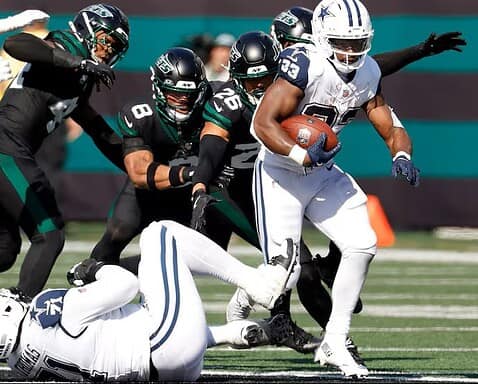
Ezekiel Elliotts don’t grow on trees, they are rare and special players. And when you have one, especially when you spend a premium pick on him, you should get the most out of him that you can. Playing winning offense in the NFL is about more than just “do you run or do you pass,” and it often hinges on creating splash plays of 15-20 yards.
If you can get those plays through the use of an elite running back, that player becomes intrinsically valuable to your team. No matter what “position” he is labeled as. Of course you want to be able create mismatches in the passing game all over the field, so when you are able to do this with a running back, shouldn’t that be deemed as highly valuable?
We can’t say just yet if the Cowboys should re-sign Ezekiel Elliott once he enters free agency. After all, five seasons (and a franchise tag year) where he touches the ball more than most players in the league will almost certainly bring about some wear and tear.
But with the way the Cowboys have chosen to play offense, and the way in which they’ve built their roster, a workhorse back like Elliott is necessary for success.
Once again, at least it is for now.
Was this helpful?










3 Comments
Comments are closed.